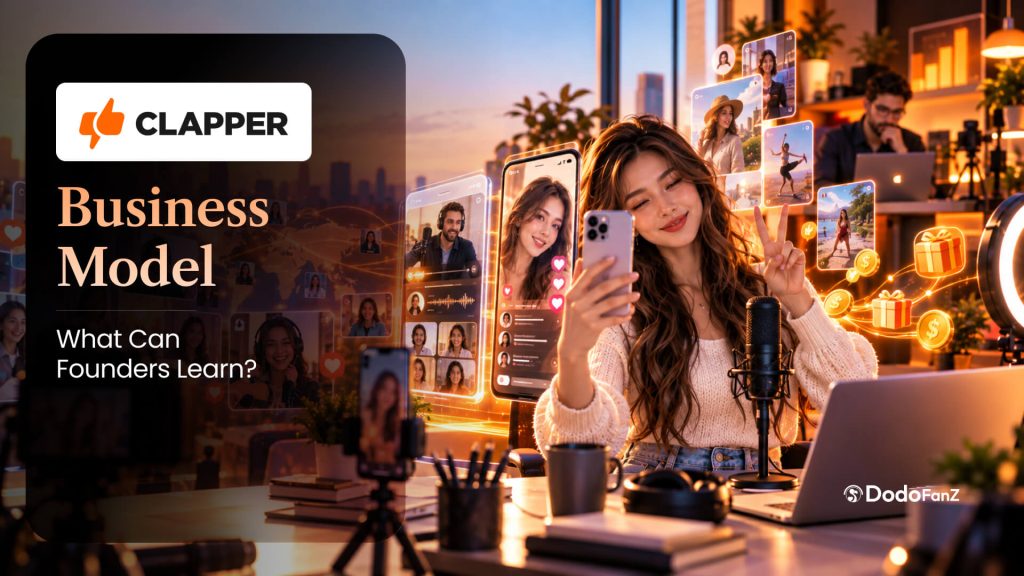

Most social media platforms first compete for attention and then monetize that attention through advertising. Clapper has taken a different route. Its product combines short-form video, livestreaming, community features, and direct creator monetization without making advertising the center of the business.
That makes the Clapper business model particularly interesting for founders. Instead of requiring creators to build enormous audiences before earning, Clapper currently promotes monetization from the beginning through virtual gifts, Clapper Shop, subscriptions, and paid communities. Its official website says creators can access monetization without follower thresholds.
The larger lesson is not simply that an ad-free social network can exist. Clapper shows how discovery, community, creator earnings, and platform economics can be designed as connected parts of the same product.
What Is Clapper?
Clapper is a social platform built around short-form video, livestreaming, audio conversations, and community interaction. Unlike social networks primarily optimized around polished influencer content and advertising inventory, Clapper emphasizes creator-community relationships and direct monetization.
Creators can publish videos, go Live, host conversations, create communities, and monetize their audiences through multiple mechanisms. Clapper’s current website specifically highlights Gifts, Clapper Shop, and Paid Group Chats as ways creators can earn. Its creator resources also describe Clapper Fam subscriptions as part of the wider monetization ecosystem.
For founders, the important distinction is where economic value originates. Clapper does not need every creator to become a massive influencer before monetization becomes relevant. Its 2026 monetization guidance says Clapper Fam, virtual gifting, and Live features are available without follower thresholds or waitlists.
That changes monetization from an eventual reward into part of the creator acquisition proposition.
How Does the Clapper Business Model Work?
At its core, the Clapper business model connects content discovery with community-driven transactions.
Short videos help creators reach people. Livestreaming and other interactive formats strengthen relationships. Community features create spaces where those relationships can continue. Monetization tools then allow some of that engagement to become recurring or transactional spending.
This creates a relatively simple flywheel:
Content Discovery -> Community Interaction -> Creator Relationship -> Transaction -> Creator Incentive -> More Content
The strength of this architecture is that monetization does not necessarily interrupt the user experience. A gift during a Live, a monthly membership, or a purchase from a creator’s Shop can emerge from behavior already happening inside the community.
Clapper also provides several ways to monetize different levels of fan commitment rather than relying on a single paywall.
| Revenue Layer | User Action | Economic Role |
|---|---|---|
| Virtual Gifts | Fans support creators during content or Lives | Transactional spending |
| Clapper Fam | Fans subscribe monthly | Recurring monetization |
| Clapper Shop | Fans purchase creator offerings | Social commerce |
| Paid Groups | Fans pay for exclusive community access | Community revenue |
This diversification is an important part of the model. A casual viewer, regular follower, paying subscriber, and highly engaged supporter do not need to behave identically for the ecosystem to generate value.
How Does Clapper Make Money?
Understanding how Clapper monetizes requires looking beyond one revenue feature. Its creator ecosystem gives users several opportunities to move from free participation toward financial support.
1. Virtual Gifts Turn Engagement Into Transactions
Virtual gifting connects creator engagement directly with spending.
Clapper allows viewers to send gifts through videos, Lives, and Radio. Livestreams make this particularly powerful because fans can respond financially while the interaction is happening. PK Battles, for example, encourage communities to support competing creators through gifts.
The business-model principle is more important than the virtual item itself.
A subscription monetizes a long-term relationship. A gift monetizes a moment of engagement.
Someone enjoying a livestream may not want another monthly subscription, but they might happily make a smaller spontaneous transaction to support the creator.
For founders, this demonstrates why monetization should match user psychology. Rather than forcing every engaged user into the same purchase, products can create different transaction types for different levels of intent.
2. Clapper Fam Adds Recurring Monetization
Clapper Fam introduces subscriptions into the social experience.
Creators can establish membership tiers with monthly pricing and provide supporters with exclusive benefits. Clapper’s current monetization guidance positions Fam as its more predictable creator income stream and encourages creators to offer different levels of access.
This gives Clapper something transaction-only platforms lack: recurring economic relationships.
The creator can continue publishing free content for discovery while offering closer access, exclusive experiences, or additional benefits to paying supporters. A fan does not have to leave the social environment and join a separate membership platform.
For the platform, recurring subscriptions can also make revenue less dependent on unpredictable one-time transactions.
3. Clapper Shop Connects Content With Commerce
Clapper Shop extends the model beyond digital fan support.
The platform currently lets creators open stores from their profiles and sell merchandise, digital products, shout-outs, video requests, and other creator offerings. Shop Live allows creators to promote listings while livestreaming.
This reduces the distance between influence and purchase.
A creator demonstrating a product or discussing their expertise does not necessarily need to send interested users through several external services before a transaction can happen. Commerce becomes another layer of the existing creator relationship.
For founders building community products, the lesson is significant: sometimes the strongest monetization opportunity is not charging users for access to the software. It is enabling transactions users already want to make and participating economically in that activity.
4. Paid Communities Monetize Relationship Depth
Clapper also allows creators to establish paid Group Chats. Its current site describes Groups as communities that can remain free or carry a monthly fee. Creators can run multiple Groups around different communities or interests.
This moves monetization beyond content itself.
Fans may pay because they want closer interaction with the creator or because they value access to the surrounding community. The product being purchased is therefore not necessarily another video. It can be belonging, conversation, access, or participation.
One current detail is important: older Clapper material also references DM Tipping and Paid Multi Live, but Clapper announced that both features were removed on August 24, 2026. They should therefore not be presented as current revenue mechanisms.
That change itself offers a useful product lesson: monetization portfolios should evolve according to actual usage rather than accumulating features indefinitely.
What Can Founders Learn From Clapper’s Business Model?
Clapper’s model provides lessons that extend beyond short-video applications. The same principles can apply to creator platforms, marketplaces, niche communities, social commerce products, and membership businesses.
Lesson 1: Give Users Access to Value Earlier
One of Clapper’s clearest differentiators is the absence of large follower thresholds before creators can begin using core monetization tools.
That matters because emerging creators face a familiar problem on large platforms: they may spend considerable time creating value before becoming eligible for meaningful platform monetization.
Clapper reverses that sequence. Its current monetization material explicitly promotes earning from the beginning rather than requiring creators to first establish a large following.
For founders, the principle is broader than creator earnings: identify something valuable incumbents make customers wait for and determine whether you can provide it earlier.
A marketplace could give new sellers faster access to buyers. A SaaS platform could provide meaningful automation before requiring an upgrade. A creator product could allow monetization before the creator becomes famous.
Removing that friction can become part of customer acquisition itself.
Lesson 2: Monetize User Success, Not Just User Attention
Advertising encourages platforms to increase impressions because attention becomes inventory.
Transaction-driven models create a different incentive. The platform benefits when meaningful economic activity happens between participants.
For a creator platform, that can mean helping creators build stronger communities, improve paid conversion, sell products, increase recurring memberships, or create more valuable Live experiences.
The founder lesson is not that transaction fees are always better than advertising. It is that the revenue model influences what the product ultimately optimizes.
Before selecting a business model, founders should ask: What behavior do we want our revenue model to encourage?
If the answer aligns with the value users themselves want from the platform, the economics can become much more naturally integrated with the product.
Lesson 3: Build a Monetization Ladder
Not every community member has the same willingness to pay.
Clapper addresses this by creating different economic relationships around its community. Users can participate for free and then move toward gifting, recurring memberships, commerce, or paid community access depending on their level of interest.
This creates a monetization ladder rather than a single binary paywall.
For founders, that can translate into several principles:
- Give free users enough value to establish a relationship before asking for payment.
- Offer low-friction transactions for people who want to contribute occasionally.
- Use recurring products for users who want an ongoing relationship.
- Reserve higher-value experiences for the most engaged members.
- Let spending deepen naturally instead of forcing every user into the same plan.
A smaller number of highly engaged users can sometimes create more economic value than a much larger audience that rarely moves beyond passive consumption.
Lesson 4: Community Can Be the Product
Many social platforms treat community as a consequence of content. Clapper demonstrates how community itself can become part of the value proposition.
A user may initially arrive because of a video but remain because they recognize the people in a Group, regularly attend a creator’s Live, or feel part of a niche conversation.
Once that relationship exists, the creator has more to monetize than content inventory.
This is particularly relevant for startups that cannot compete with established social networks on sheer content volume. A smaller product can instead create density within a specific profession, hobby, geography, demographic, or interest.
The founder objective changes from “How do we attract everyone?” to “Which group can we serve deeply enough that participation becomes habitual?”
That is a much more achievable starting point for many new social businesses.
Lesson 5: Connect Discovery, Engagement, and Monetization
Clapper’s individual features make more sense when viewed as one system.
Short-form content supports discovery. Live experiences increase interaction. Groups deepen community. Fam creates recurring relationships. Gifting monetizes spontaneous engagement. Shop captures commercial intent.
Each layer can move users toward a deeper relationship without requiring them to leave the ecosystem.
For founders, this means features should not exist simply because competitors have them. Every major feature should have a clear role in the product loop.
A useful framework is:
- Discovery: How does someone encounter valuable people or content?
- Engagement: What gives them a reason to participate?
- Relationship: What makes them return to the same creator or community?
- Monetization: Where does sufficient value exist for a voluntary transaction?
- Retention: What makes that economic relationship continue?
If these stages reinforce one another, monetization feels like part of the experience rather than an interruption.
What Founders Should Not Copy Blindly
The Clapper business model does not prove that every social startup should eliminate advertising and depend entirely on creator transactions.
Transaction-led platforms need enough users willing to spend, enough creators capable of generating that spending, and enough marketplace volume for the platform economics to work.
Founders should therefore avoid several assumptions:
- Ad-free does not mean cost-free: Video infrastructure, moderation, payments, support, and creator operations remain expensive.
- Monetization tools do not create demand: Creators still need communities willing to spend.
- More revenue features are not automatically better: Clapper itself removed underused monetization features in 2026.
- Creator acquisition is only half the marketplace: Paying and retained community members ultimately determine economic health.
- Transactions introduce operational complexity: Refunds, payouts, fraud, disputes, taxes, and compliance need proper infrastructure.
The objective should be to adapt the economics to the audience rather than copy Clapper’s feature set.
Build a Creator Platform Inspired by Clapper With DodoFanZ
Clapper demonstrates how short-form discovery, community interaction, and direct creator monetization can operate inside one ecosystem.
DodoFanZ gives founders a white-label creator economy foundation that can be customized around their own niche, audience, monetization strategy, and brand. Instead of reproducing Clapper feature for feature, businesses can develop the creator and community experiences most relevant to their market while retaining complete source-code ownership.
This gives founders a faster foundation for launching a differentiated creator platform without restricting the long-term product to being another Clapper alternative.
Also Read: Fanvue Business Model – The Economics Behind Fanvue
Final Thoughts
The most interesting part of the Clapper business model is not simply the absence of advertising. It is the economic system built around community participation instead.
Content creates discovery. Live interaction builds stronger relationships. Community features increase belonging. Gifting, subscriptions, commerce, and paid access give different users different ways to spend.
For founders, the broader lesson is to identify where genuine value is already being created inside the product and place monetization as close to that moment as possible.
A new social platform does not necessarily need to attract everyone. A smaller but deeply engaged community, strong creator incentives, and well-designed transaction mechanics can provide a more focused starting point.
Frequently Asked Questions
How does Clapper make money?
Clapper’s current ecosystem centers on creator and community monetization rather than an advertising-led model. Its product includes virtual gifting, Clapper Fam subscriptions, Clapper Shop, and paid Group Chats.
Can creators earn on Clapper without a large following?
Yes. Clapper currently states that creators can access core monetization features without minimum follower thresholds.
What makes the Clapper business model different?
Clapper connects short-form discovery and community engagement directly with creator monetization. Users can move from free content toward gifting, subscriptions, commerce, or paid community participation without those activities being separated across multiple products.
What is the biggest lesson from Clapper for founders?
One important lesson is to align monetization with behaviors users already value. Rather than adding revenue mechanics after building engagement, founders can design discovery, community, transactions, and retention as parts of the same product system.
