
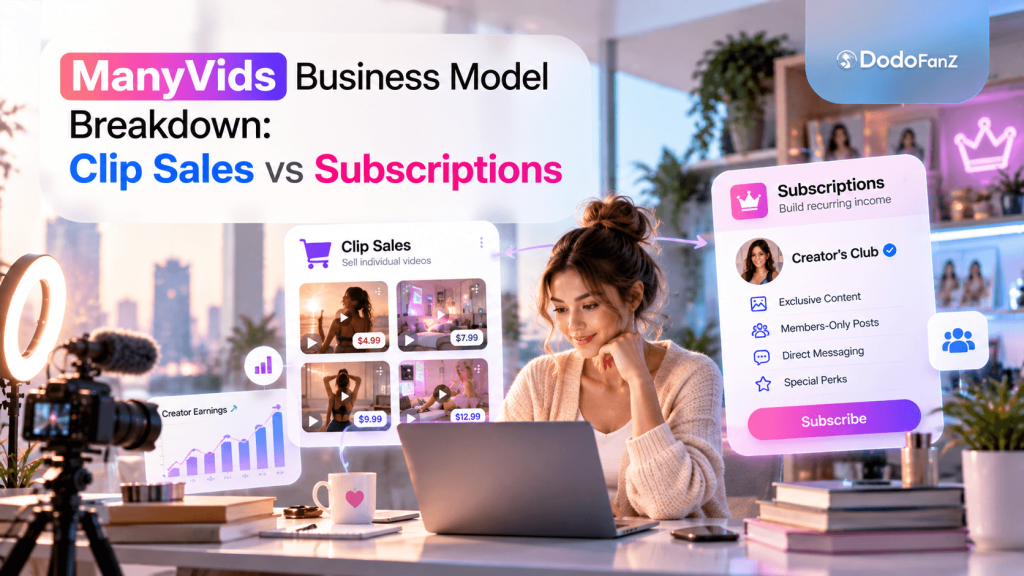

The creator economy is often associated with monthly subscriptions, but not every successful creator platform depends primarily on recurring payments. Some businesses generate revenue by turning individual pieces of content into products that customers can discover and purchase independently.
ManyVids operates across both models. Its marketplace allows creators to sell individual videos while also offering subscription-based access, custom content, tips, and other monetization opportunities.
This makes the ManyVids business model particularly interesting for founders evaluating digital content marketplaces. Unlike subscription-first platforms, ManyVids combines the economics of an ecommerce storefront with those of a recurring membership business.
The distinction matters because clip sales and subscriptions require different approaches to discovery, creator acquisition, pricing, retention, and platform development.
What Is ManyVids?
ManyVids is an adult creator platform where verified creators monetize digital content and interactions with paying customers. Its commercial model combines individual video purchases with ongoing creator memberships and additional paid offerings.
The marketplace element is particularly important. Customers can explore video listings, discover creators through categories and search, and purchase individual content without necessarily committing to a recurring subscription.
Subscriptions create a different relationship. Instead of purchasing one product, fans pay for continued access to content or benefits offered through a creator’s membership program.
For founders, ManyVids illustrates how two distinct purchasing behaviors can coexist within one marketplace: buying content because it matches an immediate interest and subscribing because of an ongoing relationship with a creator.
How Does the ManyVids Business Model Work?
At its core, the platform connects creators who produce content with customers willing to pay for it.
Creators upload and price videos, organize their storefronts, and establish membership offerings. Customers discover content, complete purchases, and receive access according to the type of transaction.
ManyVids generates platform revenue by retaining a share of qualifying transactions. The revenue arrangement can differ across product categories, meaning individual clip sales and subscription-based transactions do not necessarily have identical economics.
The underlying business combines three complementary activities: marketplace discovery attracts buyers, digital transactions monetize content, and memberships encourage ongoing customer relationships.
That hybrid architecture allows creators to serve customers who prefer occasional purchases alongside fans who want continued access.
Clip Sales vs Subscriptions: The Core Difference
| Factor | Clip Sales | Subscriptions |
|---|---|---|
| Purchase behavior | One-time payment | Recurring payment |
| Primary motivation | Specific content | Ongoing creator access |
| Growth driver | Search and catalogue discovery | Fan relationships and retention |
| Creator workload | Production and listing optimization | Consistent membership value |
| Revenue pattern | Variable individual purchases | Recurring, subject to churn |
Neither approach is universally better. Clip sales can generate revenue from customers who have no interest in a continuing membership, while subscriptions can improve predictability when creators retain paying fans.
The more important question is how each model contributes to the marketplace’s overall economics.
Clip Sales: ManyVids as a Digital Content Marketplace
Individual video sales are a defining element of ManyVids.
Creators can treat each video as a separate digital product with its own title, price, description, preview, and discovery information. Buyers can search for content matching their interests instead of needing to follow a particular creator first.
This changes the role of the platform. It becomes more than a payment destination for an audience acquired elsewhere. Its internal marketplace can help customers discover creators and products they were not previously following.
Why Clip Sales Can Create Long-Term Value
A creator produces a video once but may sell access to it repeatedly. Unlike physical products, digital files do not require manufacturing another unit for every purchase, although storage, delivery, payment processing, and support still create costs.
Over time, a creator’s catalogue can become a collection of revenue-generating assets.
A larger catalogue also creates more opportunities to match specific buyer interests. However, adding more content does not automatically produce more sales. Search relevance, competitive pricing, thumbnails, previews, and marketplace visibility remain important.
For founders, this resembles the economics of a digital goods marketplace. Product discovery and catalogue quality become central to commercial performance.
Why Search Matters More Than Follower Count
In a subscription-first model, customers often arrive because they already know the creator.
A searchable clip marketplace can capture demand from customers looking for a particular content category rather than a specific person.
This distinction gives the platform a potentially valuable acquisition role. Internal search, recommendations, category pages, and product listings can connect existing buyer demand with relevant creator inventory.
That discovery capability can also make the platform more attractive to smaller creators who have content to sell but limited external audiences.
Subscriptions: ManyVids as a Membership Platform
Subscriptions operate on a different economic principle.
Rather than purchasing a specific video, customers pay for ongoing access to a creator’s membership offering. The value comes from the continued relationship, which may include exclusive content, regular updates, or other benefits determined by the creator.
This makes subscriber retention central to the business.
A clip buyer can complete one transaction and leave satisfied. A subscriber must continue perceiving enough value to justify the next billing cycle.
For creators, memberships therefore require more attention to consistency, communication, pricing, and expectations.
The Economics of Recurring Revenue
Suppose a creator has 200 subscribers paying $10 per month. That produces $2,000 in monthly gross subscription transactions before platform fees, processing costs, refunds, and other deductions.
The recurring structure provides a useful starting point for forecasting, but it is not guaranteed income.
Subscribers can cancel, payment methods can fail, and customer preferences can change. Maintaining recurring revenue requires replacing lost subscribers while retaining existing ones.
For founders, this means subscription architecture must include more than automated billing. Renewal management, cancellation, payment recovery, subscriber analytics, and membership permissions all influence long-term performance.
Why Memberships Complement Clip Sales
The two models can serve different stages of the customer relationship.
Someone may discover a creator through an individual video purchase and later decide that ongoing membership provides better value. Conversely, a subscriber may purchase a separate premium clip that is not included in their membership.
This creates opportunities for additional revenue without requiring the platform to acquire an entirely new customer for every transaction.
The key is clarity. Buyers should understand which content is included in a subscription and which purchases require additional payment. Confusing access rules can undermine trust and increase support requests.
How ManyVids Makes Money: Revenue Streams and Commission Structure
ManyVids earns revenue by facilitating transactions between creators and buyers. However, the platform’s economics are not necessarily identical across every monetization category.
Commonly reported revenue-sharing arrangements distinguish between standalone video sales and creator-directed monetization such as memberships, tips, and custom content.
The figures below should be treated as indicative rather than guaranteed current rates because the latest contractual percentages have not been independently verified.
- Clip sales: Commonly reported creator share of approximately 60%, leaving around 40% for the platform.
- Memberships: Often reported at an 80% creator share, with the platform retaining approximately 20%.
- Custom content: Personalized content requests provide another transaction category, with reported creator shares commonly around 80%.
- Tips and additional purchases: Fans can support creators through other paid interactions, subject to the applicable product-specific terms.
The difference in reported commissions is commercially significant.
A marketplace that attracts buyers through internal search, maintains product listings, and delivers substantial volumes of video may justify different economics from a membership product where creators bring their own audiences.
However, a higher platform commission does not automatically mean a higher profit margin. Video hosting, bandwidth, payment fees, fraud prevention, moderation, customer service, and creator acquisition all influence profitability.
Which Model Is More Profitable: Clip Sales or Subscriptions?
The answer depends on whether profitability is being measured from the creator’s perspective or the platform’s perspective.
Clip sales can produce strong transaction revenue when a marketplace has effective discovery and a catalogue that continues attracting buyers. A single video may generate purchases over an extended period, although earnings can remain unpredictable.
Subscriptions provide greater revenue visibility when subscriber retention is healthy. However, creators must continue delivering enough value to justify recurring payments.
Consider two hypothetical creators.
One sells 300 clips at an average price of $8, generating $2,400 in gross transactions. Another maintains 150 subscribers paying $12 monthly, generating $1,800 in monthly gross subscription transactions.
At the illustrative revenue shares discussed earlier, the first creator would receive $1,440, while the second would receive $1,440 before any other applicable deductions.
The outcome is identical despite the different transaction volumes and business models.
This demonstrates why founders should evaluate creator earnings, customer acquisition, retention, and platform contribution margins together, rather than comparing gross revenue alone.
ManyVids Business Model Canvas
A business model canvas maps a company across nine building blocks, showing on a single page how it creates, delivers, and captures value. The canvas below applies that framework to the ManyVids business model as described in this article.
It is an analytical interpretation based on the publicly described features and commonly reported revenue arrangements discussed above, not an internal ManyVids document. Commission figures are indicative and should be verified against current creator terms.
Key Partners
- Payment processors and payout providers
- Cloud storage, video hosting, and CDN vendors
- Age and identity verification providers
- Legal and compliance advisers
Key Activities
- Marketplace search and discovery
- Video hosting and delivery
- Payments, earnings records, and payouts
- Creator verification and onboarding
- Moderation and compliance enforcement
Key Resources
- Searchable catalogue of creator video listings
- Search and recommendation technology
- Storage and streaming infrastructure
- Verified creator base
- Payment and ledger systems
Value Propositions
- Creators: sell clips, memberships, custom content, and tips from one storefront
- Creators: reach buyers through internal search, not only their own followers
- Creators: build a catalogue that can keep selling over time
- Buyers: find content by interest without following a creator first
- Buyers: buy once or subscribe, with clear access rules
Customer Relationships
- Self-serve creator storefronts
- Membership relationships that depend on retention
- Support and dispute handling
- Transparent rules on what each purchase unlocks
Channels
- Internal search, categories, and product listings
- Individual creator storefront pages
- Creator-led promotion to existing audiences
- Web platform and account area
Customer Segments
- Verified creators selling digital video
- Buyers looking for specific content
- Subscribers following a particular creator
- Smaller creators with limited external audiences
Cost Structure
- Video storage, bandwidth, and delivery
- Payment processing fees and chargebacks
- Fraud prevention and moderation
- Identity verification and compliance
- Customer and creator support
- Creator and buyer acquisition
- Product and engineering
Revenue Streams
- Clip sales: platform share commonly reported around 40%
- Memberships: platform share commonly reported around 20%
- Custom content: platform share commonly reported around 20%
- Tips and other paid interactions, under product-specific terms
- Figures are indicative and unverified against current terms
Read the canvas from the center outward. The value propositions determine which creators and buyers the platform can serve, and the revenue streams only work if the cost of video delivery, payments, moderation, and compliance stays comfortably below the platform’s take rate.
What Can Founders Learn From the ManyVids Business Model?
The most useful lessons concern marketplace design, revenue diversification, and customer behavior. ManyVids illustrates how a platform can support both product-led purchasing and relationship-led monetization.
1. Build Discovery Into the Product
Subscription platforms often depend heavily on creators bringing their own audiences. Digital marketplaces can create additional value by connecting buyers with relevant content.
For founders, this makes search, categorization, previews, and product recommendations commercially important rather than merely convenient.
A platform that consistently generates new buyers for creators has a stronger reason to retain those creators.
2. Turn Content Into Reusable Digital Inventory
A video can continue generating transactions after its initial publication. This gives digital content marketplaces a different revenue profile from platforms where most earnings depend on continuously publishing new posts.
The lesson applies beyond adult entertainment to educational videos, stock media, fitness programs, music, digital downloads, and specialized knowledge products.
Creators can build catalogues rather than relying exclusively on continuous audience engagement.
3. Combine Transactional and Recurring Revenue
Clip sales and subscriptions do not have to compete for the same customer.
Transactional products serve immediate demand. Memberships monetize continued relationships. Combining them can increase the number of ways a customer contributes revenue.
For founders, this suggests designing monetization around different purchasing intentions instead of assuming every user wants a subscription.
4. Match Commission Rates to Platform Value
A marketplace that supplies discovery, buyer traffic, hosting, and transaction infrastructure may offer creators a different value proposition from a platform that primarily processes payments for existing fans.
Commission strategy should reflect the services provided and the costs of delivering them.
Higher fees are easier to defend when creators receive measurable commercial value in return.
5. Measure Revenue Quality, Not Just Transaction Volume
A hybrid marketplace needs to understand which activities produce sustainable growth.
Important performance indicators include:
- Gross merchandise value: Total value of transactions processed.
- Take rate: The percentage of transaction value retained by the platform.
- Repeat purchase rate: How frequently clip buyers return.
- Subscription churn: The percentage of subscribers lost over a period.
- Creator earnings: Revenue creators actually receive after applicable deductions.
- Contribution margin: Revenue remaining after direct transaction and delivery costs.
These metrics help founders determine whether growth is creating a healthier marketplace or simply increasing infrastructure and operating expenses.
Challenges of Building a ManyVids-Like Marketplace
The hybrid model also introduces complexity.
A platform must maintain individual purchase permissions alongside recurring membership entitlements. Creators need accurate earnings records across transaction types, while buyers require clarity about what they own or can access.
Video marketplaces also face substantial storage, processing, and delivery requirements.
For adult-content platforms, additional considerations include age and identity verification, performer consent, content moderation, applicable recordkeeping obligations, payment-provider eligibility, privacy, and jurisdiction-specific restrictions.
These are foundational operating requirements, not optional features to address after launch.
Founders should therefore validate the target content category, payment infrastructure, compliance obligations, and marketplace economics before committing to development.
Build a Creator Marketplace With DodoFanZ
The ManyVids business model demonstrates how individual content sales and recurring memberships can support different purchasing behaviors within the same creator economy.
DodoFanZ provides a customizable white-label creator platform foundation for founders exploring premium content, subscriptions, and direct-to-fan monetization.
With 15+ creator-economy solutions, complete source-code ownership, and an average go-live time of approximately seven days for suitable ready-made implementations, DodoFanZ helps businesses establish their own branded platforms without starting every component from scratch. Actual timelines and capabilities depend on the selected solution, integrations, and customization requirements.
Founders can focus on developing a differentiated marketplace rather than reproducing ManyVids feature for feature.
Also Read: Clapper Business Model: What Can Founders Learn?
Final Thoughts
The central lesson from the ManyVids business model is that digital content monetization does not need to depend exclusively on subscriptions.
Clip sales allow creators to monetize individual products through marketplace discovery. Memberships create opportunities for recurring relationships and more predictable income. Together, they support different buyer motivations and revenue patterns.
For founders, the decision should not simply be whether clip sales or subscriptions are better.
It should be which model creates the most value for the intended creators and customers, and whether combining them improves the overall marketplace economics.
A successful hybrid platform needs more than multiple payment options. It needs effective discovery, transparent access rules, reliable financial infrastructure, creator trust, and a commercial model that rewards both content creation and customer retention.
Frequently Asked Questions
What is the ManyVids business model?
ManyVids operates a hybrid creator marketplace combining standalone digital video sales, recurring creator memberships, and other paid content or interaction formats. The platform earns revenue by retaining a share of qualifying transactions.
Is ManyVids primarily a clip-selling or subscription platform?
ManyVids has a strong clip-marketplace identity, with searchable individual video listings. However, it also supports recurring creator monetization, allowing both purchasing models to coexist.
What percentage does ManyVids take from creators?
Commonly reported arrangements suggest different commission rates for clips and other monetization categories, often around 40% and 20% respectively. These figures should be verified against the current creator agreement before being treated as contractual rates.
Which is better for creators: clip sales or subscriptions?
Clip sales can monetize searchable content repeatedly without requiring ongoing membership commitments. Subscriptions can provide more predictable revenue when creators maintain subscriber retention. The better option depends on content type, audience behavior, discovery, and creator workload.
