
The creator economy is growing fast and subscription based platforms are leading this shift. Fansly and similar platforms prove that users are ready to pay for exclusive creator content when the experience is simple and direct.
If you want to build a platform like Fansly, you are building a subscription based creator monetization system where users pay creators through monthly plans, tips, and pay per view content while the platform earns a percentage from every transaction.
This is not just a clone concept. It is a structured subscription content platform for creators that depends on payments, compliance, and retention systems working together.
From our experience working with founders, most failures happen because they focus on features instead of creator onboarding and payment flow.
What Is Fansly and How Does It Work?
Fansly launched in 2020 and positioned itself directly as an alternative to OnlyFans. Its timing was near-perfect. When OnlyFans announced (and quickly reversed) a ban on adult content in 2021, thousands of creators were already on Fansly or moving there fast.
At its core, Fansly is a subscription content platform. Creators set up a profile, post content behind a paywall, and fans pay a monthly fee to access it. The platform takes 20% of everything processed. Creators keep 80%.
That model has clearly resonated. Fansly has grown to roughly 130 million users as of 2026, making it the most significant alternative to OnlyFans in the subscription creator space.
What Fansly does well:
Tiered subscriptions (fans can pay different amounts for different access levels)
Pay-per-view messaging (creators charge per unlocked media sent in DMs)
Free trial links (convert fans who would not otherwise subscribe)
A clean mobile experience
Faster creator payouts than some competitors
That combination of features, aggressive creator incentives early on, and good timing is what built Fansly into what it is today. None of it is magic. All of it is replicable.
Fansly vs OnlyFans: What’s Different Under the Hood?
Founders often ask whether they should model their platform on Fansly or OnlyFans. The honest answer is: they are more similar than different. But the gaps matter.
| Feature | OnlyFans | Fansly |
| Subscription tiers | Single tier | Multiple tiers |
| Free trial links | Yes | Yes |
| Pay-per-view messaging | Yes | Yes |
| Content scheduling | Limited | Better native support |
| Watermarking | No | Yes |
| Referral program | Yes | Yes |
| Payout speed | Weekly | Faster, more flexible |
| Platform cut | 20% | 20% |
| Discovery/search | Weak | Slightly better |
The biggest functional difference is tiered subscriptions. Fansly lets creators offer different price points for different levels of access, with premium subscriptions ranging up to $499.99 per month and tips from $1 to $500. That pricing flexibility lets creators segment their audience effectively and capture fans at every spending level.
That one combination of tiered access and flexible pricing helped Fansly attract serious earners away from OnlyFans. If you are building a new platform, tiered subscriptions are not optional. They are expected.
What Features Does a Fansly-Like Platform Need?
Before you brief any development team or evaluate any white-label solution, get clear on what you actually need to build. Not everything needs to be in v1.
Must-have for launch:
| Feature | Why It Matters |
| Creator profiles and pages | Core identity and discovery layer |
| Subscription tiers | Fans pay monthly; multiple price points |
| Paywalled content feed | Public preview plus locked content logic |
| Pay-per-view messaging | One of the highest revenue features on any creator platform |
| Tipping | Low-friction way for fans to spend more |
| Creator KYC and age verification | Legal requirement; cannot launch without it |
| Payout system | Creators need to get paid reliably and on schedule |
| Admin dashboard | You need controls, reporting, and moderation tools |
| Mobile-responsive design | Most traffic comes from mobile |
Good to have in Phase 2:
Native iOS and Android apps
Live streaming
Scheduled posts
Creator analytics (earnings breakdown, subscriber stats, top content)
Referral and affiliate system
Free trial links
Content watermarking
Launch with the must-haves. Add Phase 2 features based on what your creators actually ask for.
Step by Step: How Do You Build a Platform Like Fansly?
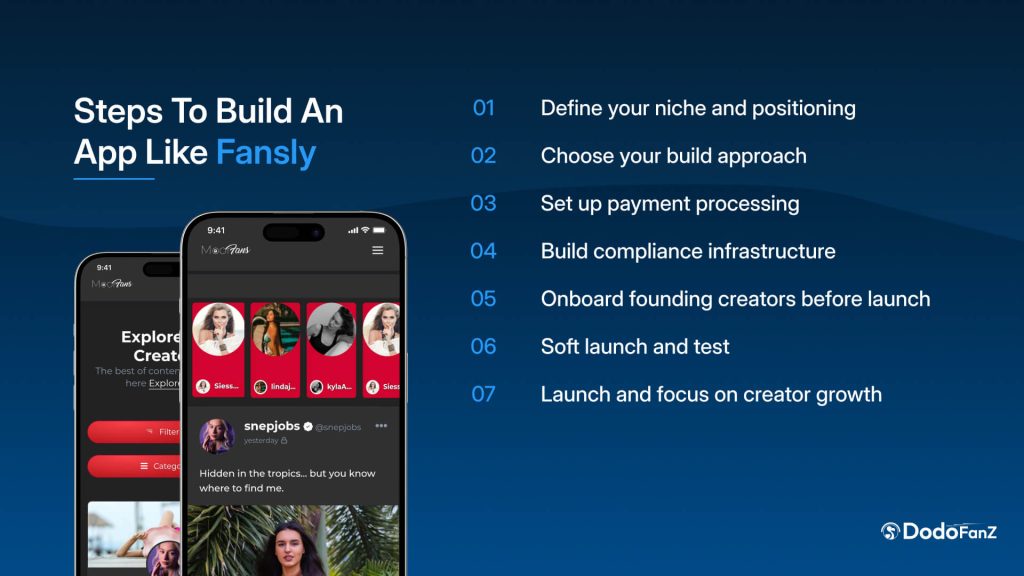
This is the part most guides make sound simpler than it is. Here is a realistic step-by-step breakdown.
Step 1: Define your niche and positioning: Are you building a general adult content platform, or targeting a specific creator category like fitness, music, or lifestyle? A niche platform is easier to market and easier to acquire creators for in the early days.
Step 2: Choose your build approach: You have two main options. Build from scratch which takes 12 to 18 months and costs $20,000 to $180,000+ depending on complexity. Or go with a white-label solution that gets you live in 4 to 8 weeks at a fraction of the cost. For most founders, white-label is the right call.
Step 3: Set up payment processing: Standard processors like Stripe and PayPal do not support adult content platforms. You need a high-risk merchant account. Providers include CCBill, Epoch, and Segpay. Get this sorted early. Payment approval can take several weeks.
Step 4: Build compliance infrastructure: KYC, age verification, 2257 record-keeping (if operating in the US), GDPR for European users, and content moderation systems all need to be in place before you go live. This is not optional.
Step 5: Onboard founding creators before launch: Aim for 20 to 50 active creators posting content before you open the platform to fans. An empty platform attracts nobody. Get supply before you chase demand.
Step 6: Soft launch and test Run a closed beta with real users. Test the full payment flow, creator onboarding, content uploads, and payout processing. Fix what breaks. Do not rush this step.
Step 7: Launch and focus on creator growth: Your first 90 days should be almost entirely about signing new creators. Run a referral program. Offer launch incentives. Partner with creator management agencies. The platform only grows when creators are earning money on it.
How Does a Platform Like Fansly Make Money?
The model is straightforward. Every time a fan spends money on the platform, the platform takes a cut. Creators keep the rest.
The standard split across Fansly and OnlyFans is 80/20. Creators keep 80% of everything they earn. The platform takes 20%. That applies to subscriptions, pay-per-view messages, tips, and paid posts.
The revenue adds up fast when you have active creators with paying fans. A creator earning $10,000 a month generates $2,000 for the platform. Scale that across hundreds of creators and the numbers become significant quickly.
Some new platforms launch at a 90/10 split for founding creators to accelerate early acquisition. Once creators are earning consistently on your platform they rarely leave, even if you adjust the split later. Getting creators in early and earning is the priority.
The more your creators earn, the more your platform earns. Your interests are fully aligned.
How Much Does It Cost to Build a Platform Like Fansly?
Cost is one of the first questions every founder asks, and the honest answer is: it depends on how you build it.
You have two routes. Build custom from the ground up, or launch on a white-label platform that is already built. The difference in cost and timeline between the two is significant.
A white-label platform starts around $5,000 to $20,000 and gets you live in weeks. A custom build starts at $20,000 for a basic platform and can reach $180,000 or more for an advanced build with AI tools and native apps.
If you go the custom route, here is how the cost breaks down by complexity:
| Platform Level | What You Get | Estimated Cost |
| Basic | Subscriptions, content feed, payments, creator profiles | $20,000 to $30,000+ |
| Mid-Range | Everything in Basic plus PPV messaging, tipping, analytics, mobile-ready design | $30,000 to $80,000+ |
| Advanced | Everything in Mid-Range plus AI tools, live streaming, native apps, custom admin | $80,000 to $180,000+ |
Most first-time founders land in the Basic to Mid-Range bracket. You do not need every feature on day one. You need the core features working well.
Beyond the build, there are ongoing monthly costs to account for. Hosting runs $500 to $5,000+ depending on your traffic. Payment processing on creator platforms is classified as high-risk, so expect fees of 3% to 10% per transaction, significantly higher than standard processors. Content moderation runs $1,000 to $5,000+ per month and cannot be handled by automation alone. You will need human moderators. Creator and fan support adds another $500 to $3,000 monthly.
For founders who want to move fast and keep upfront costs low, a white-label solution like DodoFanz is the smarter starting point.
How Long Does It Take to Build a Platform Like Fansly?
It depends entirely on how you build it.
If you build from scratch with a full development team, you are looking at 12 to 18 months before launch. That assumes no major delays, which is rare. Scope changes, payment processor approvals, and compliance work all add time.
A white-label platform cuts that down to 2 to 4 weeks. The core platform is already built. You are customizing your branding, configuring features, and getting payment accounts approved rather than writing code from zero.
If you go the open-source route with custom development on top, expect somewhere between 4 to 9 months depending on your team size and feature scope.
One thing every approach has in common: payment processor approval takes time regardless of how you build. Apply early and do not treat it as a last step.
Launch on a Platform Built for This: DodoFanz
Building a Fansly-like platform from scratch is a long road. Most founders who try it spend over a year in development before a single creator earns their first dollar.
DodoFanz offers a white-label creator subscription platform built specifically for founders who want to launch fast without cutting corners on features. Subscription tiers, pay-per-view messaging, tipping, creator dashboards, admin controls, and mobile-ready design – all included, all under your brand.
Instead of spending your budget on infrastructure, you spend it on what actually builds a business: acquiring creators, growing your audience, and making your platform the place creators want to be.
Final Takeaway
Building a platform like Fansly is not a small project. But once you understand the model, it is far less complicated than it looks from the outside.
Creators earn. The platform takes a cut. Everyone wins when creators do well. The technical foundation is proven. The market demand is real and still growing.
What separates platforms that succeed from those that do not is almost never the technology. It is whether the platform gives creators a genuine reason to show up, post consistently, and grow their income there.
Get the creator experience right. Get payments working reliably. Launch with real creators already earning. Everything else follows from that.
The window is open. The question is whether you move fast enough to use it.
Frequently Asked Questions (FAQs)
1. What is the first step to build a platform like Fansly?
The first step is defining your niche and monetization model. You must decide whether to target general creators or focus on a specific audience segment.
2. Can you launch a Fansly-like platform without coding?
Yes, you can use white-label platforms to launch quickly without coding. They provide ready-made systems for subscriptions, payments, and creator management.
3. What are the biggest risks when building a creator subscription platform?
Key risks include payment processor rejection, low creator adoption, content moderation issues, and failing to achieve early platform liquidity between creators and users.
4. How do you validate a Fansly-like platform before full development?
Validation is done by onboarding early creators, testing payment flows, and running a closed beta to check demand before investing in full-scale development.
5. What makes a creator subscription platform scalable?
Scalability depends on strong infrastructure, reliable payment systems, automated moderation tools, and a steady pipeline of creators generating consistent user engagement.
