Short-form video exploded the creator economy. TikTok crossed 1.5 billion users. Instagram Reels, YouTube Shorts, and Snapchat Spotlight quickly followed the same model. But behind this shift, a bigger opportunity emerged: platforms that focus on direct creator monetization instead of only content distribution.
To build a TikTok-like app, you need a scalable short-form video feed, a creator monetization system, and a backend infrastructure capable of handling high-volume video uploads, real-time engagement, and global content delivery without performance issues.
If you’re a founder exploring how to build a TikTok-like app, this guide breaks down everything you need to know, including core features, tech stack, development process, cost structure, and what it actually takes to launch and scale a competitive short-form video platform.
What Features Do You Need to Build a TikTok-like App?
Building a TikTok-like app means covering three layers: what users see and interact with, how creators earn, and how the platform runs behind the scenes. Skipping any one of them is where most platforms fall apart.
User-Facing Features
This is everything a viewer experiences from the moment they open the app. Get these wrong and retention dies on day one.
1. Vertical short-form video feed with autoplay and seamless looping
2. In-app video editor with trim, filters, captions, and audio overlay
3. User profiles with follow/unfollow, bio, and content grid
4. Likes, comments, shares, and social interactions
5. Search, trending page, and hashtag-based discovery
6. Push notifications for new content, followers, and activity
Creator Monetization Features
This is the layer TikTok gets wrong and where your platform wins. Creators need multiple direct earning options built in from day one.
1. Monthly and annual fan subscriptions
2. Tipping and virtual gifting during live streams and on posts
3. Pay-per-view locked content
4. Live streaming with real-time viewer interaction
5. Creator analytics showing earnings, views, and audience data
6. Multi-currency payout system
Platform and Admin Features
These keep the platform functional, moderated, and scalable from day one.
1. Admin dashboard for user and content management
2. Revenue and transaction monitoring with platform fee controls
3. Content moderation and reporting tools
4. Notification and broadcast system for platform-wide updates
Note: These are standard features required to build any TikTok-like platform. If you’re evaluating DodoFanZ as your white-label solution, talk to the team to get a current feature list and live demo.
What is the Best Tech Stack to Build a TikTok-like App?
You need a stack that handles video at scale, supports payments, and can grow without a full rewrite six months in.
Frontend: React Native handles both iOS and Android from a single codebase, which reduces build time significantly.
Backend: Node.js or Laravel (PHP) are both proven for this use case. Laravel works particularly well for subscription-based platforms because of its clean ORM and payment library ecosystem.
Video Infrastructure: This is the part most founders underestimate. You need:
1. A transcoding layer to compress and convert uploads (FFmpeg is standard)
2. A CDN to serve video globally without buffering (AWS CloudFront, Cloudflare, or Bunny.net)
3. HLS adaptive bitrate streaming so playback adjusts to the viewer’s connection speed
Database and Cloud: MySQL or PostgreSQL for structured data, Redis for caching feed data. AWS, Google Cloud, or DigitalOcean for hosting, with S3-equivalent storage for video files and thumbnails.
How Do You Build a TikTok-like App Step by Step?
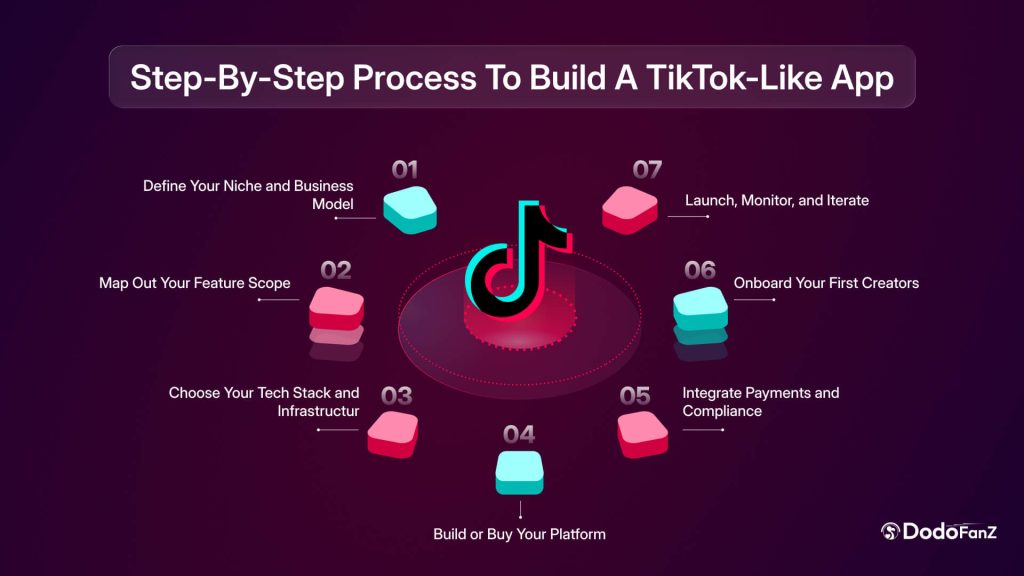
Building a short-form video platform is a sequence of decisions and development phases that stack on each other. Here is how the process looks from idea to launch.
Step 1: Define Your Niche and Business Model
TikTok targets everyone. Your platform should not. The most successful TikTok alternatives win by going narrow: fitness creators, regional audiences, adult content, music, education. Decide your niche, your monetization model (subscriptions, tips, PPV, ads), and who your core creator is before a single line of code is written.
Step 2: Map Out Your Feature Scope
Not every feature needs to be live on day one. Separate your must-haves from your nice-to-haves. A working vertical feed, creator profiles, basic upload, and one monetization method is a valid MVP. Live streaming, duets, and an advanced algorithm can come in version two.
Step 3: Choose Your Tech Stack and Infrastructure
Pick your frontend framework, backend, video encoding layer, CDN, and cloud hosting before development begins. These decisions affect your speed, scalability, and cost for years. Changing your stack mid-build is expensive and time-consuming.
Step 4: Build or Buy Your Platform
This is the fork in the road. Custom development gives you full control but takes 6 to 12 months and significant upfront investment. A white-label solution like DodoFanZ gets you live in 7 days with full source code ownership at a fraction of the cost. Most first-time founders choose white-label to validate fast, then customize from there.
Step 5: Integrate Payments and Compliance
Set up your payment gateways based on your content type. For adult platforms, CCBill, NowPayments, and Cardinity are the go-to options. For SFW platforms, Stripe and PayPal work. If you are targeting EU or UK users, build in age verification and GDPR compliance before launch, not after.
Step 6: Onboard Your First Creators
A platform without creators is an empty feed. Before you open to the public, recruit 20 to 50 creators in your niche directly. Give them early access, help them set up profiles, and make sure they are posting before your first user signs up. Content density on launch day determines whether new users stay or leave.
Step 7: Launch, Monitor, and Iterate
Go live, watch your analytics closely, and prioritize fixes based on where users drop off. Watch time per session, creator sign-up completion rate, and first subscription conversion are the three numbers that matter most in the first 90 days.
How to Build a Content Discovery Algorithm for Your Video App?
The algorithm is not optional. Short-form videos get 2.5x more engagement than long-form on social platforms, and that engagement is driven almost entirely by personalized feed logic. A chronological timeline is not why users come back.
At minimum, your discovery engine should factor in:
1. Watch time (did the viewer finish the video?)
2. Engagement rate (likes, comments, shares relative to views)
3. Creator follower growth momentum
4. Content recency for trending sections
5. Individual user interaction history
You do not need machine learning on day one. A weighted scoring system based on these signals is a solid starting point. Layer in ML once you have enough data to train on.
How Do TikTok-like Apps Make Money?
On TikTok, creators earn fractions of a cent per view. On your platform, they can earn directly and predictably. That difference is your competitive advantage. More than 50% of creators earn under $15,000 per year across existing platforms, which means there is a real, unmet demand for platforms that pay creators better.
| Model | How It Works | Platform Cut |
| Subscriptions | Fans pay monthly to unlock a creator’s full library | 10-20% |
| Tips and gifts | One-time payments during live streams or on posts | Per transaction |
| Pay-per-view | Individual posts priced separately | 10-20% |
| Paid DMs | Fans pay to send a message or unlock a reply | Creator sets price |
| Premium tiers | Bronze, Silver, Gold fan access levels | Tiered per creator |
Building multiple monetization rails from the start increases creator earnings and reduces churn. A creator earning $5,000/month on your platform does not leave.
How Much Does It Cost to Build a TikTok-Like App?
The cost to build a TikTok-like app from scratch typically ranges from $20,000 to $100,000+, depending on features, design complexity, team location, and tech stack. Here is how those costs break down by component:
| Component | Estimated Cost ($) |
| Basic UI/UX Design | $2,000 – $7,000 |
| Core Features (upload, feed, profiles) | $8,000 – $20,000 |
| Video Editing Tools | $5,000 – $15,000 |
| AI Recommendation Engine | $10,000 – $30,000+ |
| Backend and Database | $8,000 – $20,000 |
| QA and Deployment | $3,000 – $8,000 |
| Total Estimated Cost | $20,000 – $100,000+ |
Apps with only essential features fall near the lower end. Costs rise significantly as you add advanced modules like AI recommendations, real-time video editing, AR filters, and live streaming.
The white-label alternative: A DodoFanZ white-label deployment starts under $5,000, includes full source code ownership, and goes live in 7 days. No hidden post-deployment charges, no monthly SaaS fees. You own it outright from day one.
| Approach | Timeline | Cost |
| Custom build (freelance) | 9-14 months | $20,000 – $100,000+ |
| Custom build (agency) | 8-12 months | $50,000 – $250,000+ |
| White-label (DodoFanZ) | 7 days | Under $5,000 |
How Long Does It Take to Build a TikTok-Like App?
Timeline depends heavily on your approach. Here is a realistic breakdown by development phase for a custom build:
| Phase | What Gets Built | Estimated Time |
| Discovery and planning | Architecture, feature scope, tech decisions | 2-4 weeks |
| Backend and API development | User auth, video pipeline, payments, database | 8-12 weeks |
| Frontend (iOS and Android) | Feed, profiles, upload flow, subscriptions | 8-12 weeks |
| Algorithm and feed logic | Personalization, trending, search | 3-5 weeks |
| QA and testing | Bug fixes, load testing, security audit | 3-4 weeks |
| Launch prep | App store submissions, deployment, monitoring | 2-3 weeks |
Total for a custom build: 6 to 12 months depending on team size and scope. A full-featured platform with live streaming, subscriptions, and a working algorithm takes closer to 12 months.
With a white-label solution like DodoFanZ, this entire timeline compresses to as little as 7 days.
DodoFanZ for TikTok-Like App Development Launch
DodoFanZ is a white-label creator subscription platform designed for founders who want to launch a creator monetization platform or short-form video app quickly without sacrificing essential features. It includes subscriptions, tipping, pay-per-view content, and live streaming out of the box, along with full source code ownership and no post-deployment fees.
The platform supports adult-friendly payment gateways such as CCBill, NowPayments, and Cardinity, plus age verification through Didit and Yoti. With GDPR-compliant architecture and ready-to-deploy iOS, Android, and web apps, founders can launch a branded short-form video platform in as little as 7 days.
Final Thoughts
The opportunity is real. Creators are actively looking for platforms that pay them fairly and give them direct access to their audience. The mistake most founders make is spending months and significant budget building infrastructure before validating a single idea.
The smarter path is to launch fast, validate your niche, and build from there. A white-label solution gets you live in days, not months. If you are ready to move from idea to live platform, DodoFanZ is built exactly for that.
Frequently Asked Questions (FAQs)
1. How do you scale a TikTok-like app to millions of users?
Scaling requires CDN-based video delivery, load-balanced backend servers, database sharding, and adaptive streaming to handle high concurrent traffic without buffering or platform crashes.
2. What is the biggest technical challenge in video sharing app development?
The biggest challenge is video processing at scale, including encoding, storage optimization, and real-time streaming without latency or quality loss across different devices globally.
3. Do you need AI to build a TikTok-like recommendation system?
No, an MVP can use weighted engagement signals like watch time, likes, and shares. AI/ML becomes useful only after large user data is collected.
4. How do creator payouts work in a monetized video platform?
Creator payouts are handled through integrated payment gateways that track earnings from subscriptions, tips, and PPV, then distribute revenue after platform commission deduction.
5. What is the minimum viable feature set for launching a TikTok clone app?
An MVP needs video upload, short-form feed, user profiles, engagement tools, and one monetization method like subscriptions or tipping before adding advanced features.