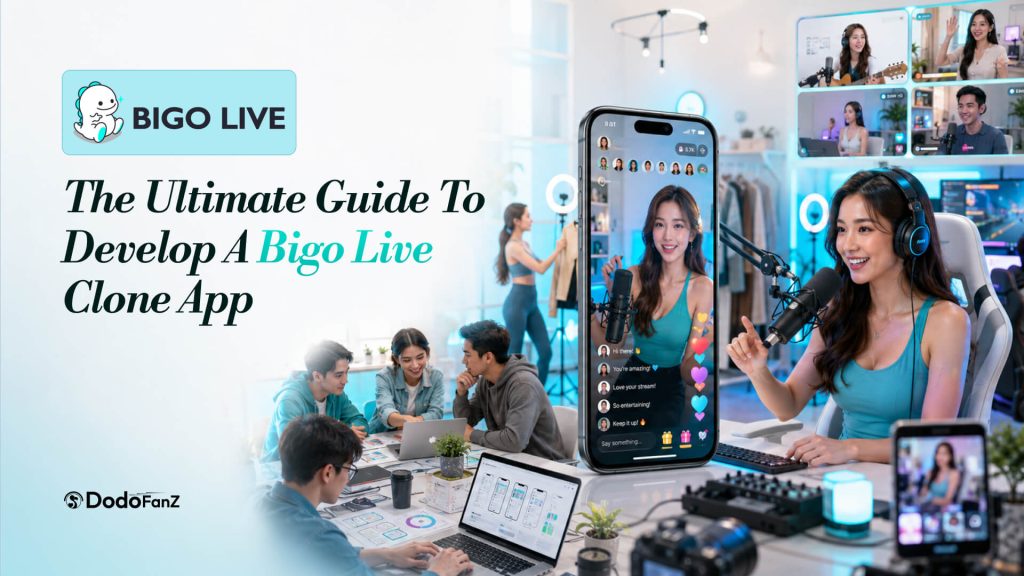

Livestreaming has evolved far beyond online broadcasting. Today, platforms like Bigo Live combine real-time video, creator monetization, virtual gifting, and community engagement into thriving creator economies. For founders, this presents an opportunity to build more than a streaming app – it offers the chance to launch a business where creators earn, audiences interact, and the platform grows through continuous engagement.
Whether you’re targeting gamers, musicians, educators, influencers, or regional creator communities, success depends on balancing technology with a sustainable monetization strategy. This guide explores how Bigo Live works, the features your platform needs, the technology behind livestreaming, development costs, and the decisions that matter before launching.
What Is Bigo Live?
Bigo Live is a real-time livestreaming platform where creators broadcast to audiences while interacting through live chat, virtual gifts, multiplayer sessions, and community features. Unlike traditional video-sharing apps, livestreaming creates immediate conversations that encourage viewers to participate rather than simply consume content.
Its business model revolves around helping creators monetize their audiences through virtual gifts, subscriptions, and premium experiences while allowing the platform to earn a percentage of every transaction. This combination of entertainment, engagement, and monetization has made livestreaming one of the fastest-growing segments of the creator economy.
How to Develop an App Like Bigo Live: Step-by-Step
Developing a Bigo Live-like app requires more than integrating livestreaming technology. A successful platform combines reliable streaming infrastructure, creator monetization, audience engagement, moderation, and scalable cloud architecture into a single ecosystem. Following a structured development process helps founders validate their business model faster while avoiding costly product and infrastructure mistakes.
Step 1: Identify Your Target Creator Community
Before writing a single line of code, define who your platform is being built for. Trying to compete with Bigo Live across every creator category is expensive and rarely successful. Instead, focus on a specific audience such as gamers, musicians, educators, fitness creators, or regional influencers. A niche-first approach simplifies product development, lowers acquisition costs, and helps you build a stronger community.
Questions to answer before development:
- Who are your primary creators?
- What type of content will dominate the platform?
- How will your platform differentiate from existing livestreaming apps?
Step 2: Build an MVP Around Core Livestreaming Features
Your MVP should validate your business idea rather than replicate every feature available on mature livestreaming platforms. Start with the features creators need to broadcast, interact with audiences, and earn revenue. Everything else can be introduced after validating market demand.
Your MVP should include:
- User registration and creator profiles
- One-tap live broadcasting
- Live chat and reactions
- Virtual gifting
- Creator wallets
- Push notifications
- Basic moderation tools
Step 3: Prioritize Creator Monetization
Creators are the supply side of your marketplace. If they cannot earn consistently, they will move to another platform regardless of how good your streaming quality is. Design monetization into the platform from day one instead of treating it as a future enhancement.
Popular monetization models include:
- Virtual gifts
- Paid subscriptions
- Fan memberships
- Tips and donations
- Premium live events
Step 4: Invest in Reliable Streaming Infrastructure
A livestreaming platform succeeds only when broadcasts remain smooth and responsive, even during peak traffic. High latency, buffering, or stream failures directly impact user retention, making infrastructure one of the most critical technical investments.
Recommended technologies:
- Agora or WebRTC for real-time streaming
- AWS or Google Cloud for scalability
- Amazon S3 and CDN for media delivery
- FFmpeg for video processing
Step 5: Build Community Beyond Streaming
Livestreams bring users to the platform, but community features keep them coming back. Encourage interaction before, during, and after broadcasts to increase watch time and improve creator retention.
Engagement features to consider:
- Live chat
- Emoji reactions
- PK battles
- Multi-host rooms
- Creator collaborations
- Audience polls
Step 6: Implement Moderation and Safety
As your platform grows, maintaining a safe environment becomes just as important as adding new features. Strong moderation improves user trust, protects creators, and reduces compliance risks.
Essential moderation tools:
- Content reporting
- User blocking
- Chat filters
- Moderator controls
- AI-assisted content moderation
Step 7: Launch, Learn, and Iterate
Avoid spending months perfecting features before acquiring users. Launch with a lean MVP, onboard a small group of creators, gather feedback, and continuously improve the platform based on real usage data. This approach reduces investment risk while helping you reach product-market fit faster.
Step 8: Scale Through Creator Programs
Once your platform gains traction, shift your focus from building features to expanding the creator ecosystem. Referral programs, agency management, featured creators, and performance incentives help attract new broadcasters while increasing engagement across the platform.
Growth initiatives that work well include:
- Creator referral programs
- Agency onboarding
- Featured creator campaigns
- Performance-based rewards
- Regional creator partnerships
Why Livestreaming Platforms Continue to Grow
Livestreaming is becoming increasingly attractive because audiences value authentic, real-time interactions over heavily edited content. According to Grand View Research, the global live-streaming market exceeds $100 billion and is expected to grow steadily throughout the decade, driven by creator monetization, live commerce, gaming, and virtual events. The World Economic Forum has also highlighted how digital entrepreneurship and creator-led businesses are reshaping online economies.
For founders, this means livestreaming is no longer just a content format – it’s a scalable business model.
| Growth Driver | Why It Matters |
| Creator economy expansion | More creators seeking monetization opportunities |
| Live audience interaction | Higher engagement and longer watch time |
| Virtual gifting | Sustainable platform revenue |
| Mobile-first consumption | Larger addressable audience |
Why Bigo Live’s Business Model Works
Bigo Live succeeds because it creates value for every participant in the ecosystem. Viewers receive entertainment and interactive experiences, creators generate income, agencies recruit and manage talent, advertisers reach engaged audiences, and the platform earns through transactions and premium services.
This creates a self-reinforcing growth loop. The more creators earn, the more content they produce. More content attracts additional viewers, which increases gifting activity and overall platform revenue. Instead of depending solely on advertising, livestreaming platforms diversify revenue across multiple stakeholders, making the business model more sustainable over time.
Essential Features of a Bigo Live-Like App
Building a successful livestreaming platform requires more than reliable video streaming. It should encourage creators to broadcast consistently while making viewers active participants in every session.
Your MVP should include:
- One-tap live broadcasting with HD streaming
- Multi-host rooms and PK battles
- Live chat, reactions, and audience engagement
- Virtual gifting and in-app wallet
- Creator profiles and monetization tools
- Content moderation and reporting
- User notifications and discovery feeds
Once product-market fit is achieved, advanced capabilities such as fan subscriptions, exclusive events, AI-powered recommendations, and agency management can be introduced.
Technology Stack for a Scalable Livestreaming Platform
Real-time video applications demand low latency, high availability, and scalable infrastructure. Choosing proven technologies reduces development risk and ensures consistent streaming quality as the platform grows.
| Layer | Recommended Technologies |
| Mobile Apps | Flutter or React Native |
| Backend | Node.js or Django |
| Streaming | Agora, WebRTC or Twilio |
| Database | MongoDB or MySQL |
| Cloud Infrastructure | AWS or Google Cloud |
| Storage & CDN | Amazon S3 with CloudFront |
Cloud-native architecture is particularly important because livestreaming platforms experience unpredictable traffic spikes during popular broadcasts and events.
Build From Scratch or Choose a White-Label Solution?
One of the first decisions founders face is whether to develop the platform entirely from scratch or launch using a white-label solution. Custom development provides complete flexibility but often requires significant investment, longer development timelines, and ongoing engineering resources.
White-label solutions, on the other hand, provide pre-built livestreaming infrastructure, creator monetization systems, and core engagement features, allowing founders to validate demand and enter the market much faster. For most startups, reducing time to market creates a stronger competitive advantage than rebuilding standard functionality from the ground up.
How Much Does It Cost to Develop a Bigo Live Clone?
Development costs vary depending on the product scope, streaming infrastructure, creator economy features, and scalability requirements. While a basic MVP requires a considerably smaller investment than an enterprise-grade livestreaming ecosystem, technology represents only one part of the overall budget.
Founders should also account for creator acquisition, cloud infrastructure, moderation teams, payment processing, and ongoing platform operations. As livestreaming activity increases, infrastructure and content moderation costs often grow alongside user engagement, making operational planning just as important as software development.
Don’t Overlook the Agency Model
Many successful livestreaming platforms accelerate growth through agency networks rather than relying solely on individual creator signups. Agencies recruit broadcasters, manage talent, improve creator retention, and help platforms scale content production without building large internal teams.
For startups entering competitive markets, implementing an agency module can significantly reduce creator acquisition costs while increasing livestream frequency and audience engagement.
Marketing Your Livestreaming Platform
Technology alone rarely determines success. The strongest platforms launch with a clear go-to-market strategy focused on attracting both creators and viewers.
Rather than competing directly with established platforms, focus on serving a specific audience such as gaming communities, musicians, educators, fitness professionals, or regional creator ecosystems. Partnering with established creators during launch provides immediate credibility, while competitive monetization programs encourage them to bring their existing audiences onto the platform.
Common Mistakes Founders Should Avoid
Many livestreaming startups struggle because they invest heavily in technology while overlooking creator growth and community building.
Avoid these common mistakes:
- Trying to compete directly with global platforms instead of targeting a niche.
- Delaying creator monetization until after launch.
- Underestimating cloud infrastructure and streaming costs.
- Ignoring moderation and platform safety.
- Building too many features before validating demand.
- Focusing on viewers without a clear creator acquisition strategy.
The strongest livestreaming businesses grow because creators succeed first, not because they simply offer better technology.
Final Thoughts
Developing a Bigo Live-like app is about building a creator economy rather than a livestreaming application. While reliable streaming technology is essential, long-term success depends on empowering creators to grow communities, engage audiences, and generate sustainable income through virtual gifting, subscriptions, and premium experiences.
By launching with a focused MVP, targeting a specific creator niche, and refining the platform through real user feedback, founders can significantly reduce risk while accelerating growth.
Looking to launch your own white-label livestreaming platform? DodoFanZ helps startups build scalable Bigo Live-style platforms with creator monetization, virtual gifting, agency modules, and enterprise-ready infrastructure so you can enter the market faster and focus on growing your creator community.
Frequently Asked Questions
What is a Bigo Live clone?
A Bigo Live clone is a white-label livestreaming platform with features such as real-time broadcasting, virtual gifting, creator monetization, live chat, and audience engagement.
What features are essential for an MVP?
Core features include live broadcasting, creator profiles, virtual gifting, live chat, moderation tools, notifications, and content discovery.
How much does it cost to build a Bigo Live-like app?
Costs depend on platform complexity, streaming infrastructure, monetization features, and scalability requirements. White-label solutions generally reduce both development time and initial investment.
How do livestreaming platforms generate revenue?
Most platforms earn through virtual gifts, subscriptions, premium memberships, advertising, sponsorships, and transaction commissions.
Can startups compete with Bigo Live?
Yes. The most effective strategy is to target niche creator communities, regional markets, or industry-specific audiences rather than competing directly with global livestreaming platforms.
