


The Fanfix business model is built around direct-to-fan monetization. Instead of relying primarily on advertising, Fanfix gives creators ways to turn their existing audiences into paying communities through recurring memberships, paid direct messages, locked content, and other premium interactions.
The core economics are simple. Under Fanfix’s current creator terms, creators receive 80% of qualifying direct fan payments, while Fanfix retains 20%. The model therefore aligns Fanfix’s revenue with creator earnings.
For founders planning to build an app like Fanfix, the bigger lesson is not simply to add subscriptions. Fanfix demonstrates how creator selection, recurring revenue, premium access, brand-safe positioning, and layered monetization can work together as one creator economy business.
What Is Fanfix?
Fanfix is a creator monetization platform designed to help creators earn directly from their audiences. Rather than functioning primarily as a mass-market discovery network, it gives creators infrastructure for monetizing fans who want exclusive content or closer interaction.
Creators can offer memberships, publish exclusive content, sell locked content, charge for direct interactions, and participate in additional revenue programs. Fanfix describes its ecosystem as a safe, brand-friendly environment for creators and fans.
That positioning is important to the Fanfix business model. The platform is effectively monetizing the relationship between a creator and the most commercially valuable portion of their audience.
How Does the Fanfix Business Model Work?
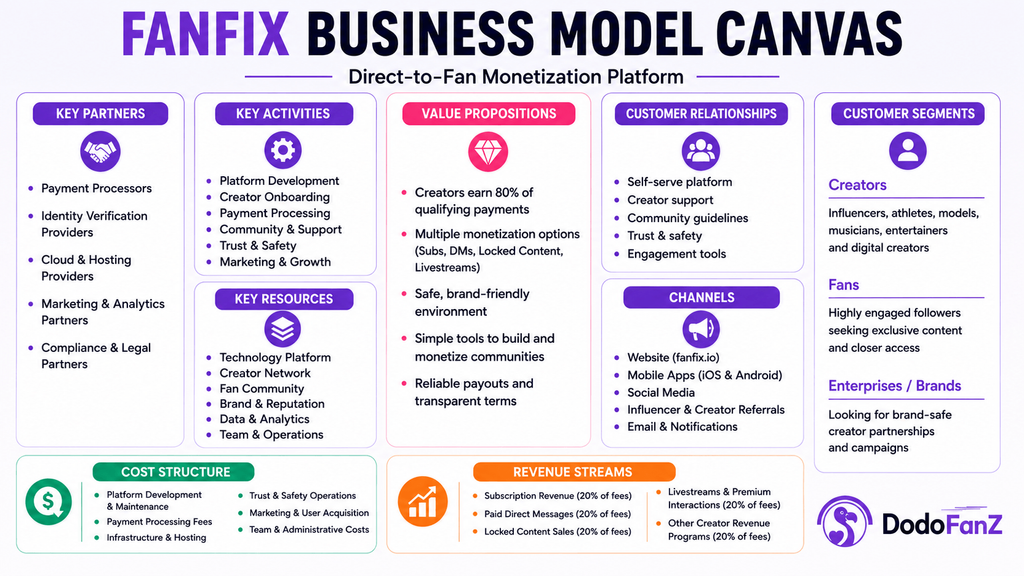
The basic transaction is straightforward:
Creator builds an audience -> fan pays for premium access -> Fanfix processes the transaction -> creator receives 80% -> Fanfix retains 20%.
Fanfix’s August 2026 Creator Terms state that this split applies to direct payments from memberships, direct messages, locked content, and other qualifying revenue programs.
| Example Fan Payment | Creator Share | Fanfix Share |
| $10 | $8 | $2 |
| $25 | $20 | $5 |
| $50 | $40 | $10 |
| $100 | $80 | $20 |
These are illustrative calculations based on Fanfix’s stated 80/20 split, not fixed Fanfix prices.
For an app like Fanfix, this percentage-based model has an obvious advantage: platform revenue scales with creator transaction volume without requiring the platform to sell advertising against every piece of content.
How Does Fanfix Make Money?
Fanfix’s monetization model has multiple transaction layers, but they share one principle: give fans more than one reason to spend.
1. Membership Subscriptions
Recurring memberships are one of the foundations of the Fanfix business model.
Creators can offer renewable memberships that unlock exclusive content or other benefits. Fanfix also supports multiple membership tiers, allowing creators to differentiate access based on what fans are willing to pay.
Subscriptions are particularly valuable because they convert audience loyalty into recurring revenue. Instead of starting every month at zero, creators can build a base of paying members.
Fanfix benefits from the same predictability because it earns its platform share when qualifying membership payments occur.
2. Paid Direct Messaging
Not every fan values the same experience.
Some followers simply want content. Others are willing to pay for closer access to a creator.
Fanfix therefore allows fans to pay for direct messaging interactions. Its current terms also contemplate video calls through designated third-party providers.
This creates a higher-value monetization layer above subscriptions. A creator can monetize not only what they publish, but also access to interaction.
For founders building an app like Fanfix, that distinction matters. Monetization should reflect different levels of fan intent rather than treating every paying user identically.
3. Locked Content
Fanfix also enables creators to put individual content behind a paywall.
Creators can send locked content to followers, who must pay the specified amount to unlock it. Fanfix determines minimum pricing while allowing creators to set approved prices above that threshold.
This creates a useful combination:
- Memberships monetize ongoing access.
- Locked content monetizes individual premium experiences.
- Paid messaging monetizes direct interaction.
Fanfix has also expanded messaging functionality with pay-to-unlock text and creator tools that show details such as membership tier and lifetime fan revenue.
That is more sophisticated than simply putting a subscription button on a creator profile.
Why the 80/20 Revenue Split Matters
Fanfix retaining 20% of qualifying transactions is one of the defining economics of the Fanfix business model.
Consider a creator generating $20,000 in qualifying monthly fan payments. Under the stated split, the creator share would be $16,000 and Fanfix’s share would be $4,000, before considering any other applicable terms or charges.
The platform therefore has a strong incentive to help creators increase transaction volume.
But this also creates pressure on Fanfix to justify its fee. Creators can compare monetization platforms, so the product must provide enough value through payments, fan management, monetization features, engagement tools, and infrastructure to make the revenue share worthwhile.
This is a crucial lesson for anyone designing an app like Fanfix: commission percentage means little in isolation. What matters is how much net income the platform helps creators generate.
Fanfix’s Brand-Safe Positioning Is Part of the Model
Fanfix does not compete only through monetization features.
Its current policies explicitly emphasize maintaining a safe and brand-friendly environment. The platform restricts prohibited and inappropriate content and establishes rules around creator and fan interactions.
That positioning gives Fanfix a distinct identity within the direct-to-fan market.
It can appeal to mainstream social creators who want premium monetization without building their businesses around an adult-content ecosystem. It can also make the environment more compatible with brands, creator managers, and agencies.
For founders, this demonstrates that positioning itself can create differentiation. An app like Fanfix does not necessarily need radically different technology if it serves a clearly defined creator category better.
Fanfix vs Other Creator Monetization Models
Fanfix operates in a crowded direct-to-fan market, but different platforms optimize for different creator relationships.
| Platform | Primary Model | Core Positioning |
| Fanfix | Memberships + paid interactions | Brand-friendly creator monetization |
| Patreon | Memberships + digital products | Broad creator membership ecosystem |
| OnlyFans | Subscriptions + premium interactions | Direct-to-fan monetization |
| YouTube | Ads + memberships + commerce | Discovery and creator monetization |
The lesson is that memberships themselves are not a competitive moat.
The stronger differentiator is who the platform serves, why those creators choose it, how effectively fans convert, and how much creators can earn after joining.
Why the Fanfix Business Model Works
The model combines recurring revenue with variable fan spending rather than depending on a single transaction type.
A fan can begin as a follower, become a member, purchase locked content, and pay for direct interaction. This creates opportunities to increase revenue from the same audience without requiring creators to continuously acquire new fans.
Fanfix also benefits from creator-led distribution. Creators can bring audiences accumulated elsewhere into their monetization ecosystem.
The resulting economics can be understood as:
Existing audience -> paying members -> premium interactions -> higher fan value -> creator earnings -> Fanfix revenue
That is a substantially different growth mechanism from an advertising platform that primarily needs more impressions.
Fanfix Is Expanding Its Creator Financial Infrastructure
One of the more important 2026 developments is Fanfix’s new payout infrastructure.
Fanfix says its redesigned system is expanding support for international creators, separating pending and available balances, and allowing automatic payouts on weekly, bi-weekly, or monthly schedules.
More importantly, the platform says its infrastructure is being prepared for features such as built-in agency revenue splits, referral earnings, and instant withdrawals.
That signals an evolution from basic creator monetization toward broader creator-business infrastructure.
As creators professionalize, platforms must increasingly support managers, agencies, revenue sharing, international payments, and more complex financial relationships.
What Founders Building an App Like Fanfix Can Learn
Copying Fanfix’s feature list would be the wrong takeaway. The stronger lessons are structural.
- Build around creator economics. Creators stay when the platform generates meaningful income, not because it has more buttons.
- Create multiple spending layers. Memberships, locked content, and paid interactions address different levels of fan willingness to pay.
- Use recurring revenue as the foundation. Transactional purchases can increase revenue, but memberships provide greater predictability.
- Choose a clear creator segment. Brand-safe positioning gives Fanfix differentiation beyond technical functionality.
- Plan financial infrastructure early. Payouts, revenue splits, international payments, refunds, disputes, and compliance become critical as the marketplace scales.
A successful app like Fanfix therefore needs more than creator profiles and paywalls. It needs sustainable economics for creators, fans, and the platform simultaneously.
Also Read: ReelShort vs DramaBox: Top Short Drama Apps Compared
Build an App Like Fanfix With DodoFanZ
The Fanfix business model shows how subscriptions become more powerful when combined with premium content and direct fan interactions. DodoFanZ helps founders build an app like Fanfix with memberships, premium content, paid messaging, creator monetization, livestreaming, fan engagement, and creator management features.
Rather than creating another generic Fanfix copy, founders can launch around a specific creator niche, geography, or monetization strategy while retaining complete source-code ownership and the flexibility to customize the platform as the business grows.
Final Thoughts
The Fanfix business model is ultimately built around monetizing fan loyalty rather than simply monetizing audience reach.
Its 80/20 structure means Fanfix participates directly in creator transaction revenue, while memberships establish recurring income and locked content and paid interactions provide additional opportunities to increase fan value.
For founders planning an app like Fanfix, the biggest lesson is not to copy its commission percentage or feature set. The real opportunity is to design a platform where creators have compelling reasons to bring their audiences, fans have meaningful reasons to pay, and the platform earns revenue when those relationships become more valuable.
That alignment between creator earnings, fan engagement, and platform revenue is the real engine behind the Fanfix business model.
Frequently Asked Questions
What is the Fanfix business model?
The Fanfix business model is based on direct-to-fan monetization. Creators earn through memberships, direct messages, locked content, and other paid programs, while Fanfix retains a percentage of qualifying transactions.
How does Fanfix make money?
Fanfix’s current Creator Terms state that creators receive 80% of direct payments from qualifying revenue programs and Fanfix retains the remaining 20%.
What are the main Fanfix monetization features?
Fanfix currently supports renewable memberships, membership tiers, paid direct messaging, locked content, and additional paid creator programs.
Is Fanfix subscription-based?
Yes. Creators can offer renewable memberships, including different membership tiers with varying content or benefits.
What makes Fanfix different from other creator platforms?
One important distinction is its emphasis on a safe and brand-friendly creator environment alongside direct-to-fan monetization.
Can you build an app like Fanfix?
Yes. An app like Fanfix can combine creator profiles, memberships, premium content, paid interactions, fan management, payouts, and other monetization tools. The stronger business opportunity is usually to differentiate around a specific creator niche or market rather than copying Fanfix exactly.
